
The Postbank credit card lineup combines classic credit-card functionality with account-linked options for people who want tighter spending control.
This guide focuses on banking services around the cards and the transaction fees that matter most in everyday use and travel.
Postbank Mastercard options and what each one is for
Postbank offers a standard Mastercard credit card with a clear annual-fee structure and typical card features like worldwide payments.
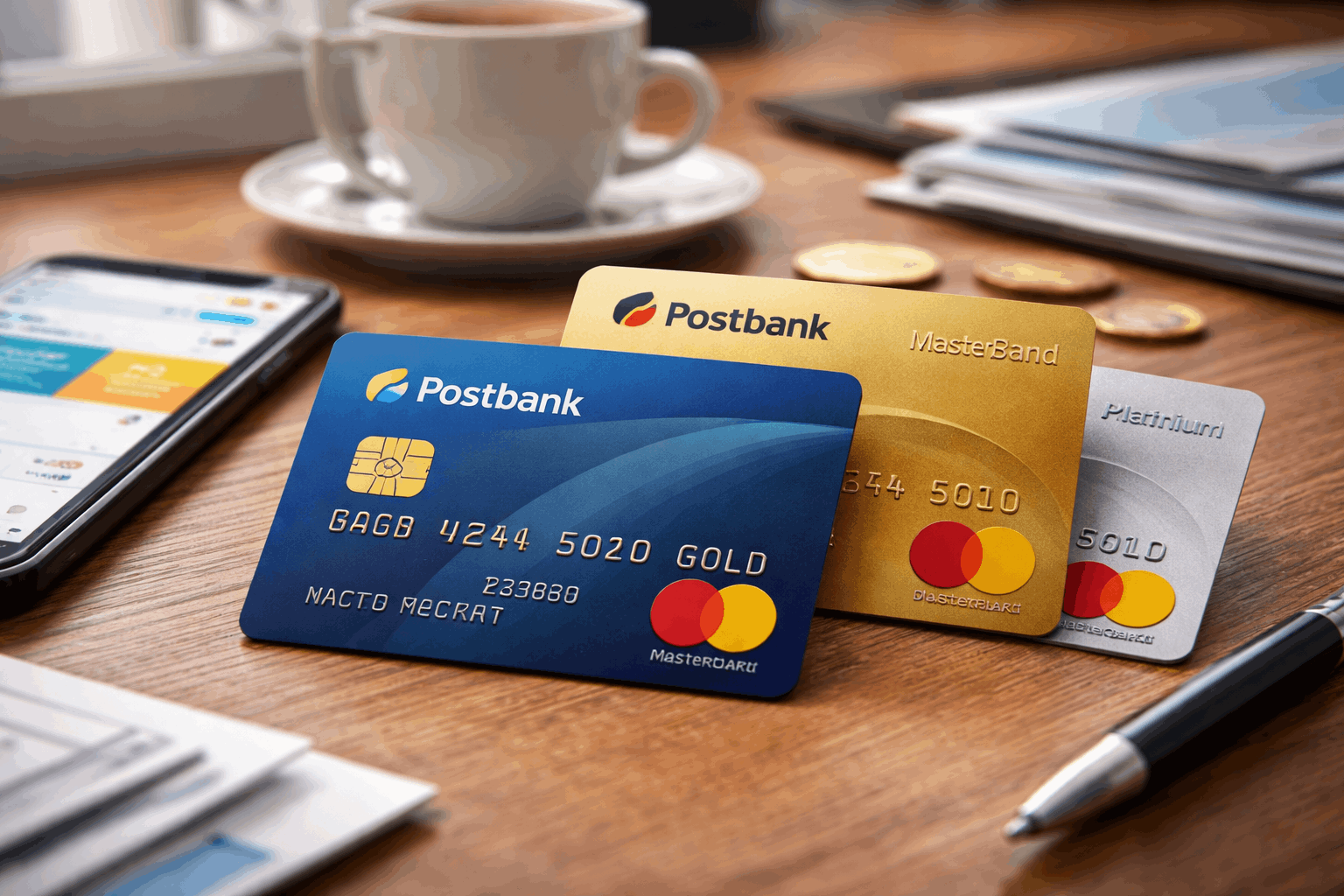
There are also premium tiers (Gold and Platinum) designed around bundled travel and purchase protections, plus added services.
Separately, the Postbank card Plus Mastercard product is not a credit card, because transactions are debited directly from the linked giro account.
That mix matters because fees, acceptance use-cases, and “credit vs. direct debit” behavior are very different across the lineup.
Postbank Mastercard (standard credit card)
The annual fee for the main card is listed as €29.00, with an additional card priced separately.
Cash withdrawals are priced differently depending on location, with stated percentage fees and minimum euro amounts.
The card also has an explicit “abroad usage” surcharge model that depends on EU/euro versus non-EU or non-euro transactions.
Postbank Card plus (direct-debit card, not a credit card)
Postbank states the Card Plus has credit-card-like acceptance, but no credit function, because amounts are charged directly to the giro account.
The annual fee shown for the main Card Plus is €18.00/year (for online or phone completion).
Postbank also publishes specific rules for cash withdrawals (including partner ATMs) and foreign usage surcharges for this card.

Banking Services
Postbank wraps its banking services around three main channels.
1) Online & mobile banking services
View balances and transactions, and get better visibility through spending analysis/categorization features in the Postbank app.
Common “service” tasks like updating details and making appointments are typical day-to-day account maintenance needs.
2) Telephone banking (when you don’t want to log in)
Postbank promotes telephone banking as a convenient way to handle account business “where and when you want.”
They describe using voice input to request actions such as balance/transaction info and making transfers.
3) Cash services
The Postbank app listing includes “Cash” features aimed at helping users find ways to get cash quickly.
Core transaction fees you should understand before using the card
The biggest cost drivers for most users are cash withdrawals, foreign usage surcharges, and any separate currency-conversion charges.
Postbank publishes these items directly on product pages, including the percentage fees and minimum euro amounts for withdrawing cash.
For foreign usage, the standard pattern shown is 0% in EU countries when paying in euros, and a 1.85% surcharge outside that scope.
Postbank also notes that an additional “currency conversion fee” can apply as defined in the bank’s price and services documentation.
Cash withdrawals in Germany and abroad
For the standard Mastercard, Postbank lists cash withdrawals at a bank counter as 3% (minimum €5.00).
For ATM withdrawals on the standard Mastercard, Postbank lists 2.50% (minimum €5.00) and a daily limit of €1,000.
Postbank also notes a specific exception tied to a giro account variant where the foreign ATM fee is not charged for certain customers.
Foreign usage and currency conversion
The foreign usage surcharge is 0% for transactions in EU states when the transaction currency is the euro.
The surcharge is 1.85% for transactions outside the EU and/or in other currencies.
Currency conversion charges are handled under the bank’s documented FX rules.
Postbank Mastercard Gold vs Platinum: fees and service differences
The simplest comparison starts with annual fees and then checks which premium services you will actually use.
Postbank’s own overview documents list Gold at €49/year and Platinum at €99/year for the main card, which is a meaningful price gap.
Platinum explicitly includes Priority Pass access pricing, while Gold is positioned around insurance coverage without that lounge-service emphasis.
Both premium cards still share the same foreign-usage surcharge model (EU/euro vs other).
Gold: cost, withdrawals, and abroad surcharge
Postbank lists the Gold annual fee as €49.00 for the main card and provides the related cash-withdrawal pricing on the product page.
Postbank lists the abroad surcharge as 0% in EU/euro and 1.85% otherwise, with an additional reference to currency conversion rules.
Postbank also describes Gold as including an insurance package (travel and purchase-related protections), which is the primary “value lever” for frequent travelers.
Platinum: cost, Priority Pass pricing, and abroad surcharge
Postbank lists the Platinum annual fee as €99.00 for the main card and €79.00 for an additional card.
Postbank states Priority Pass lounge visits are priced at €33.32 per person per visit, which is important for estimating real-world lounge cost.
Postbank lists the same abroad surcharge pattern, including 1.85% outside EU/euro, plus the bank’s currency conversion rules reference.
Postbank Mastercard vs Visa: what to compare in practice
Both Mastercard and Visa are business-card sections, showing that the bank’s card ecosystem can include both networks depending on product type.
For Mastercard-based products shown here, Postbank references Mastercard/ECB exchange-rate sources and its own currency conversion fee rules.
The decisive factor should be the exact fee sheet and benefits package attached to your offer rather than the network name alone.
Acceptance and travel usability
Postbank emphasizes worldwide usage and cash access across its Mastercard products, which is the baseline travel expectation.
For Card Plus, Postbank highlights Mastercard acceptance while also stating the direct-debit behavior that keeps spending “account-bound.”
Customer support, bank address, and key documents to keep handy
Postbank’s customer service contact is published as 0228 5500 5500 in the bank’s precontractual information materials.
For the official legal contact and address details (imprint), use Postbank’s “Impressum” page because it is maintained as the authoritative reference.
For card-specific self-service actions, Postbank points users to its online banking and card service areas linked from the product pages.
Conclusion
If you want a traditional credit card with clear costs, the Postbank Mastercard is for you.
Before you apply or switch, verify the latest terms in the linked PDFs and keep the official phone contact saved for disputes and urgent account questions.
Disclaimer: This article is for general information only and does not constitute financial advice or a personalized product recommendation. Fees, eligibility rules, and partner services can change, so always confirm the current conditions in Postbank’s published product pages and documents. For binding details (including official address information), rely on Postbank’s legal “Impressum” and the official price and services documentation. If any term in your contract differs from what is summarized here, your contract documents and Postbank’s official publications take precedence.