Global shipping only works when time, compliance, and visibility line up. DHL Express runs that playbook at scale across more than 220 countries and territories, backed by a workforce of over 110,000 International Specialists and a dedicated air network counted in the hundreds of freighters.
Time-definite service, real-time status, and predictable handoffs define the offer, especially for document and parcel moves where minutes matter. DHL Group materials and recent press updates point to continued growth in aircraft capacity and global coverage.
What DHL Express Does In Global Logistics
Express shipping focuses on time-definite international deliveries that hit a promised day and, in many lanes, a precise time window.
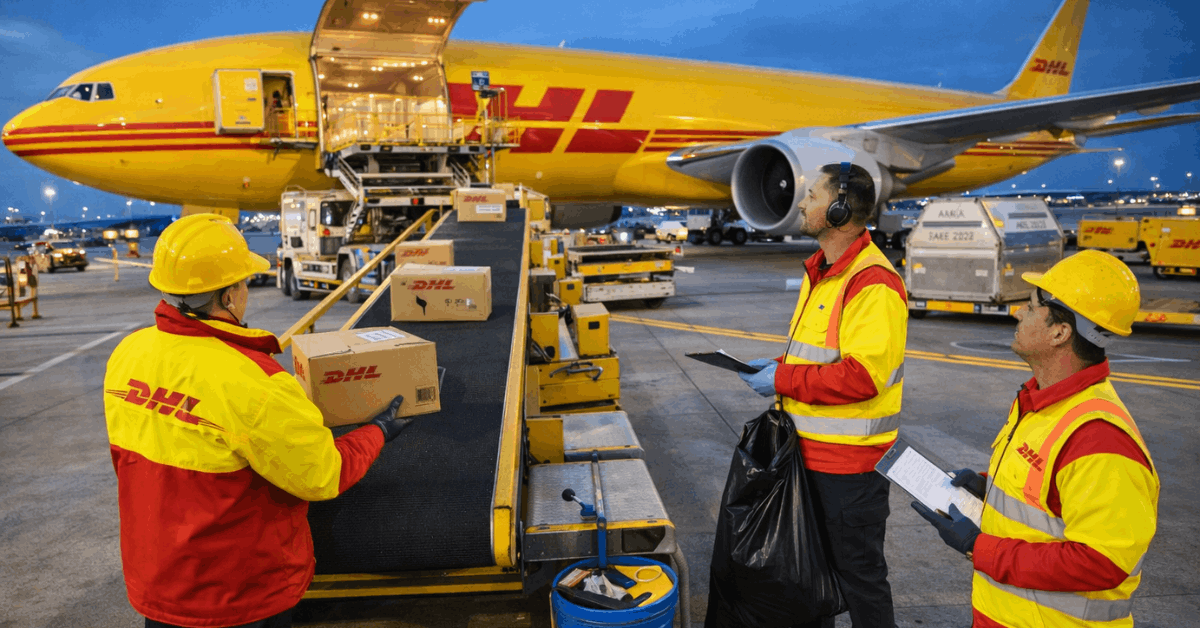
That promise depends on a closed network: integrated pickup, standardized documentation, controlled linehaul via dedicated aircraft, and tightly managed last-mile delivery.
Intelligent routing selects the fastest path through air hubs and gateways while end-to-end tracking surfaces each scan, flight, and handover so customers see progress without calling support.
Operations lean on a pull principle, where customer orders initiate movement rather than pushing stock on speculation. That approach reduces idle inventory and prioritizes shipments with confirmed demand, especially for small parcels and critical documents.
Customs clearance specialists manage import and export rules, security programs, and pre-arrival data to shorten clearance times and keep the time-definite international promise.
Courier Responsibilities At DHL Express
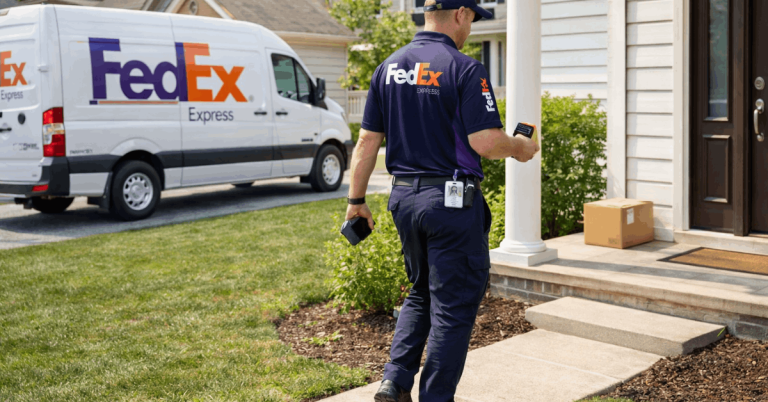
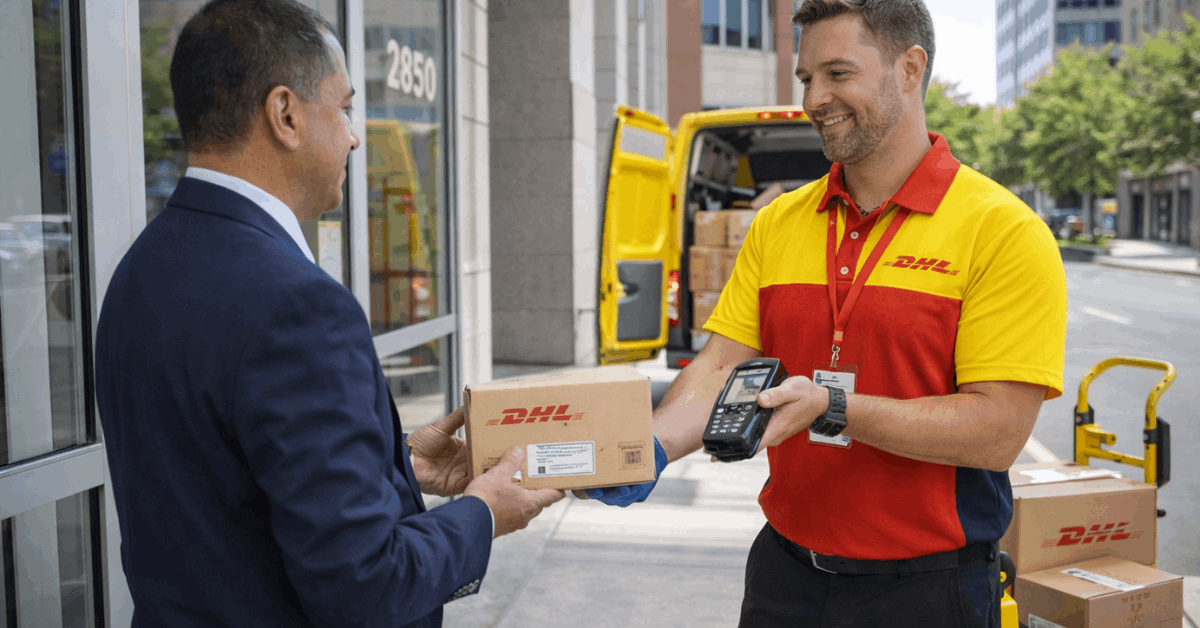
Couriers anchor the customer-facing side of the network. Daily work starts with precise route assignments that balance density and promised delivery windows while protecting safety standards.
Collection and delivery require careful scan discipline so every movement updates status instantly and drives accurate estimated times of arrival.
Documentation
Documentation matters as much as speed in cross-border work. Couriers verify airway bills, commercial or proforma invoices for non-documents, and any required permits at pickup to prevent holds later.
Secure handling, signature capture, and attention to high-value or time-sensitive items protect the chain of custody. Vehicle operation includes defensive driving, parking awareness in dense areas, and fuel-efficient habits aligned to company training.
Handheld scanners and GPS devices provide real-time visibility and support proof-of-delivery images where allowed.
How The Express Network Moves Shipments
Air capacity sets the ceiling for speed. DHL Express operates a global air network with more than 320 dedicated aircraft, supplemented by partner airlines and purchase-air agreements to flex capacity during peak seasons.
Additional Boeing 777 freighters and regional additions continue to raise long-haul and trans-Pacific throughput. Network control shortens recovery after weather or air traffic disruptions because re-routing happens inside a single, integrated operation.
Customs is engineered into the timeline rather than treated as a black box. Dedicated teams file entries, confirm tariff classifications, and apply security programs so consignments clear at speed. High-sensitivity verticals, such as life sciences, ride specialized solutions like Medical Express that manage temperature, packaging, and timing requirements end-to-end.
DHL Divisions Compared
Expect DHL Express to handle urgent, door-to-door parcels under time-definite rules. DHL Global Forwarding aggregates freight for air, ocean, and road, where weight and volume dominate.
DHL Supply Chain designs and runs warehouses and contract logistics across industries. DHL eCommerce Solutions builds domestic and cross-border parcel flows and last-mile delivery at non-urgent speeds.
| Division | Core Use Case | Typical Shipment | Speed Profile | Notes |
| DHL Express | Time-definite, door-to-door parcels and documents | Non-palletized, urgent | Fastest, guaranteed delivery windows | Integrated network and end-to-end tracking |
| DHL Global Forwarding | Air, ocean, and road freight forwarding | Larger cargo, pallets, consolidations | Planned lead times | Brokerage, multimodal moves, project cargo |
| DHL Supply Chain | Contract logistics and warehousing | Inventory across DCs and sites | Programmed SLAs | Design, operate, and optimize facilities |
| DHL eCommerce Solutions | Domestic and cross-border parcels | Non-urgent B2C and B2B parcels | Economy to expedited | Last-mile delivery and returns at scale |
Division structures and descriptions reflect official DHL Group materials and division pages.
Performance Drivers Behind Reliability
Just-in-time logistics cuts storage costs and keeps parcels moving, but reliability comes from training and standard work on the ground. Courier, warehouse, and gateway teams adopt repeatable processes for scanning, loading, and aircraft turnarounds, minimizing misloads and delays.
Strategic partnerships extend coverage where a domestic champion strengthens service; the Blue Dart alliance in India is a long-standing example, pairing DHL’s global air network with a dense national footprint.
Technology investment focuses on speed and accuracy rather than novelty. Logistics Trend Radar research from DHL highlights warehouse automation as a near-term disruptor, especially indoor mobile robots that accelerate picking and replenishment without full facility rebuilds. Those gains compound when merged with intelligent routing across linehaul and last mile.
Logistics Basics For Businesses
Logistics covers the planning, movement, and storage that get a product from origin to consumption. Scope includes transportation, warehousing, inventory management, order processing, packaging, and returns.
Supply chain management sits above logistics as the end-to-end coordination of sourcing, production, and distribution among multiple parties. Treat logistics as the execution layer where service commitments turn into scan events, truck doors, flight numbers, and delivered parcels.
Seven Rs
The “Seven Rs” provide an easy test: the right product, quantity, time, condition, place, customer, and cost. Teams use those constraints to design service levels, choose carriers, and set warehouse layouts that support predictable order cycles.
Clear definitions avoid the mistake of blaming strategy issues on the last mile when the bottleneck sits upstream in stock positioning or purchase order timing.
Key Logistics Processes
Strong programs turn on a few repeatable processes that can be measured and improved.
Brief scope and guidance: Procurement sets inputs and service terms. Storage and inventory design create speed in picking. Order picking and dispatch translate demand into shipments at the correct service level. Transportation links those steps into a coherent network.
- Procurement: Source materials or finished goods from qualified suppliers, negotiate lead times, and define quality checks that protect downstream cycle time.
- Storage: Design slotting, layout, and capacity plans so fast movers sit near packing and dispatch while safety stock remains accessible.
- Inventory Management: Track stock and turnover rates, align buffers to forecast error, and surface exceptions early.
- Order Picking And Dispatch: Use scan-verified picks, weight checks, and dock scheduling to prevent mis-ships and staged delays.
- Transportation: Align mode, carrier, and route to the promised delivery speed and total landed cost.
Why Logistics Quality Shapes Customer Experience
Delays and stockouts directly shift behavior. ECR Europe’s Optimal Shelf Availability study found that 37 percent of shoppers switch brands when faced with an out-of-stock event, a clear signal that fulfillment gaps convert to lost demand rather than patience.
Express networks mitigate part of that risk by shrinking lead times and increasing delivery predictability, but upstream inventory accuracy still sets the baseline.
Visibility reduces anxiety and contact volume. End-to-end tracking and proactive exception alerts allow customers to plan around delivery windows, which supports higher satisfaction with time-sensitive orders. Domestic parcel flows benefit from last-mile delivery options such as lockers and neighbor drop, where permitted, reducing failed attempts and cost per stop.
How To Optimize A Logistics Strategy
Define goals first: cost reduction, revenue lift via higher service levels, lower overstock, or faster delivery cycles. Translate those goals into measurable metrics such as on-time delivery rate, order accuracy, and average delivery time.
Small layout changes like placing top sellers near packing stations improve picking speed, while route planning tools reduce drive time and fuel consumption in dense delivery areas.
AI in Planning and Execution
McKinsey research shows early adopters of AI-enabled supply chain management improved logistics costs by 15 percent, cut inventory levels by 35 percent, and raised service levels by 65 percent compared to slower peers.
Gains come from better demand signals, dynamic safety stocks, and automated exception handling, not magic. Start with clean data, targeted pilots, and clear success criteria before scaling across warehouses or markets.
Choosing a Partner for Business
Partner selection depends on shipment profile and service promises. High-urgency cross-border parcels align with DHL Express for time-definite international moves, while palletized freight and containerized loads fit forwarding.
Third-party logistics (3PL) providers bridge gaps in warehousing, fulfillment, and transportation when in-house capacity would dilute focus or capital. A business account with a global express carrier enables negotiated rates, pickup windows, and dedicated support that help stabilize growth.
Where DHL Express Fits In Your Mix
Express belongs in the portfolio when failure costs are high, timing is tight, or visibility is non-negotiable. Typical triggers include legal documents, high-value electronics, urgent samples, warranty replacements, or healthcare shipments.
The dedicated air network, customs clearance specialists, and standardized pickup-to-delivery workflow reduce handoffs and shorten the distance between a confirmed order and a signed delivery.
Service Selection Should Mirror Risk
Time-definite lanes protect revenue-critical deliveries, economy lanes handle non-urgent cross-border parcels, and optional returns solutions simplify post-purchase experiences. Volume spikes around promotions or peak seasons benefit from capacity that scales without rewriting processes every week.
Conclusion
Fast, compliant, and visible movement is the point of express logistics, not a slogan. DHL Express delivers that through a controlled network, trained couriers, end-to-end tracking, and customs expertise, thereby shortening clearance.
A clear division map within DHL Group lets teams choose the right service for each job, while performance drivers such as intelligent routing, warehouse automation, and just-in-time logistics keep costs predictable as volumes scale.
Treat logistics as a disciplined system, and the benefits show up in customer satisfaction, cycle time, and working capital.